Carbon Offset Safari: How Green Safaris Is Making Sustainable Travel in Africa Tangible
Green Safaris | April 23, 2026
What does it actually mean to offset a safari?
A carbon offset safari is only meaningful if the impact is real. In an industry where the phrase “sustainable safari in Africa” is often used loosely, the challenge is turning intention into something measurable, visible, and accountable.
At Green Safaris, sustainability is not something we position as a general idea. It’s something we try to make tangible. Through our Wings & Wheels program, we connect remote destinations across Zambia and Malawi while taking responsibility for the carbon footprint of that travel. That approach was recently recognised at the WTM Africa Responsible Tourism Awards 2026, where Green Safaris was named One to Watch for real, measurable impact.
Our Wings & Wheels model was designed to make travel across Zambia seamless. But ease of travel comes with responsibility. A true carbon offset safari needs a clear, traceable connection between journey and impact. For us, that connection starts on the ground.
For further context on the award recognition, see the WTM Africa 2026 Responsible Tourism Awards winners.
The reality on the ground
In rural communities around Livingstone, firewood is not a lifestyle choice. It is the main available source of energy for most households. Nearly 99% of households rely on firewood for cooking and bathing, using an average of 292 kilograms per month.
That level of dependency creates pressure on surrounding forests, contributes to rising carbon emissions, and requires significant time spent collecting fuel. For responsible tourism in Africa to have meaning, it has to respond to realities like this.
Firewood usage in rural Zambia
Up to 99% of rural households in Zambia rely on firewood, with typical usage ranging between 150–400 kg per household per month (often averaging around 250–300 kg depending on household size and cooking practices
A practical solution, built locally
Rather than offsetting emissions through something abstract or distant, we focused on a practical clean cooking initiative that Africa can stand behind. The programme supports cookstoves that are built locally, tested in real homes, and refined through real feedback.
These stoves are made using locally available materials, can adapt to different cooking styles, and can be maintained without specialised parts. That matters because it means the solution does not disappear when outside support does. It becomes part of the community and part of everyday life.
How a carbon offset safari can reduce carbon emissions in tourism
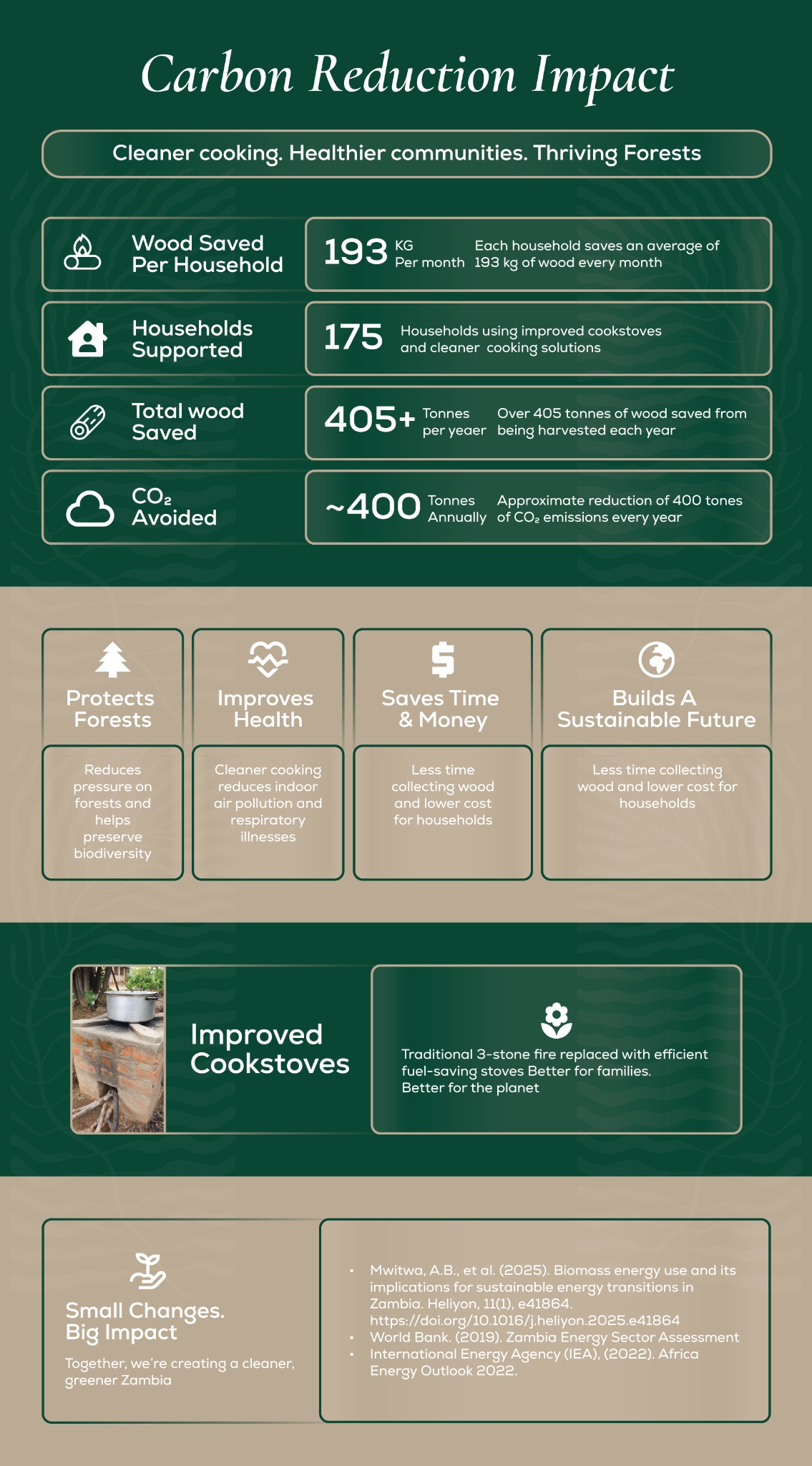
This is where an eco-safari in Zambia story becomes something you can measure, not just describe. Each stove reduces firewood usage by approximately 193 kilograms per household per month. Across the current rollout of 175 households, this results in more than 405 tonnes of wood saved every year.
In carbon terms, that equates to roughly 400 tonnes of CO₂ emissions avoided annually. These are measurable outcomes, and importantly, they directly offset the annual carbon footprint generated by our Wings & Wheels operations. The journeys that bring guests into these landscapes are balanced by a system that helps reduce the carbon emissions tourism creates at source.
Carbon reduction impact
Wood saved per household: 193 kg per month
Households supported: 175
Total wood saved: 405+ tonnes per year.
CO₂ avoided: ~400 tonnes annually
Beyond carbon: everyday impact
The environmental numbers matter, but what matters just as much is what this looks like in everyday life. For households using these stoves, the change is immediate. Less firewood is needed. Less time is spent collecting it. Household fuel costs come down. Cooking becomes safer and more efficient. Pressure on surrounding forests is reduced.
Because the stoves are built locally, they can be repaired and maintained within the community itself. That independence is what makes a single intervention sustainable over time. This is where Community Conservation Zambia moves from idea to reality.
From offsetting to regeneration
Wings & Wheels does not sit in isolation. It forms part of a broader regenerative model. Through the Green Safaris Foundation, funded by a portion of tourism revenue and donations, tourism revenue is reinvested in systems that restore ecosystems and strengthen livelihoods.
That wider work includes regenerative agriculture, water restoration, reforestation, wildlife protection, and community-led development. The cookstove initiative is one part of that system. Still, it is an important one because it connects daily life, environmental pressure, and carbon reduction in a way that is immediate and measurable.
Read more about the Foundation here: Green Safaris Foundation.
Scaling the impact
The first phase currently supports 175 households in Mponda Seniority. The next phase will expand to 350 households, with future potential to reach more than 1,000 households in surrounding communities.
As the programme grows, so does its ability to reduce carbon emissions linked to tourism while supporting more families at a local level. This is how sustainable safari Africa scales: not through broad claims, but by building on solutions that already work.
Transparency and accountability
Carbon offsetting is often criticised for being difficult to verify, and rightly so. To ensure transparency, Green Safaris is developing a digital mapping system to track each installed stove. This helps ensure that the programme remains transparent, measurable, and verifiable over time.
Sustainable safari travel in Africa requires measurable impact, not broad claims.
Why this matters for eco safari travel in Zambia and Malawi
There is often a tension between luxury travel and sustainability, as though the two cannot comfortably coexist. But when approached thoughtfully, they can support each other.
Through our sustainable safari approach on the Green Safaris website and the work of the Green Safaris Foundation, tourism becomes a mechanism for real change. Wings & Wheels makes it easier to move through Zambia and Malawi’s beautiful and untamed spaces, while this clean cooking initiative ensures that the environmental impact of that journey is actively reduced.
The result is a model of carbon offset safari travel that is practical, measurable, and local. Not just a concept, but something that works.
Explore our safaris, learn more about our sustainable safari approach, and see the broader work of the Green Safaris Foundation.
FAQs
What is a carbon offset safari?
A carbon offset safari balances the emissions generated by travel with initiatives that reduce or avoid carbon elsewhere. In this case, that balance comes through a clean cooking initiative that reduces firewood use and emissions in Zambia.
How does Wings & Wheels reduce carbon emissions in tourism?
Wings & Wheels simplifies travel logistics, while its associated carbon footprint is offset through fuel-efficient cookstoves that significantly reduce firewood consumption and CO₂ emissions.
Why focus on cookstoves instead of tree planting?
Cookstoves deliver immediate, measurable reductions in emissions. Tree planting remains valuable, but it usually takes far longer to deliver the same level of verifiable short-term carbon impact.
How does this support community conservation in Zambia?
The initiative reduces pressure forests, lowers household fuel costs, improves everyday safety, and supports locally built solutions that communities can maintain independently.
Is this initiative measurable?
Yes. The programme tracks wood savings and CO₂ reductions, with a digital mapping system in development to improve transparency and accountability over time.